

Financial services firms have no more than two years to embed artificial intelligence into their core operations or risk being left behind, FintechOS founder and chief executive Teo Blidarus has warned.
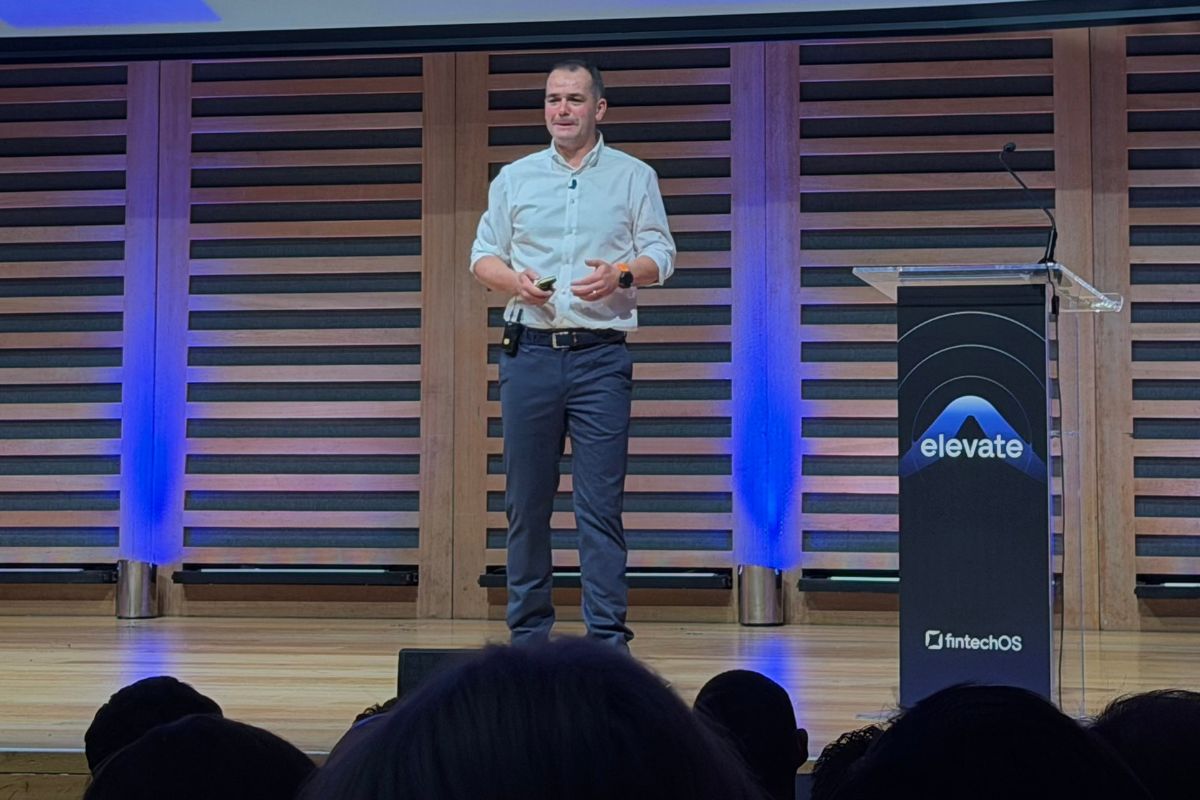
Opening the FintechOS Elevate ’26 conference in London, Blidarus (main picture) said AI would increasingly undertake much of the work surrounding underwriting, pricing and credit decisions, but predicted humans would remain accountable for the decisions themselves.
He argued that the biggest obstacle to deploying AI effectively was not the technology but the fragmentation of products, pricing, workflows and data across financial services businesses.
While AI has already been successfully deployed in areas such as call centres and chatbots, Blidarus said its ability to transform core lending operations would depend upon bringing information and processes together.
HUMANS REMAIN ACCOUNTABLE
Blidarus drew a comparison with radiology, where predictions that AI would replace radiologists have not materialised despite the technology becoming increasingly capable of analysing medical images.
He said: “If you’re looking at where we are in terms of underwriting, pricing, credit decisions and so on and so forth, I think we’re still, and we’re still going to be, in a place where every decision has a human accountable for it.
“This is decided by the regulator. Therefore, it is the law. It’s not something that’s going to change.”

However, Blidarus said the work required to reach those decisions would increasingly be performed or supported by AI.
He added: “Whenever there’s an interaction with an underwriter, or with a broker, or with somebody from product management, or with a customer or partner, I think we’re all going to do a better job being assisted by AI.”
That could include conversational tools, contextual analysis and assembling documents and information before a human makes the final decision.
FRAGMENTED SYSTEMS HOLD BACK AI
Blidarus said financial services firms often focus on fragmented data when trying to understand why AI projects fail, but argued the underlying problem starts much earlier.
He said: “Data fragmentation is typically a consequence of product fragmentation, journey fragmentation, solution fragmentation. That’s how you end up with fragmented data.”
Product rules may sit within a core system, workflows can be distributed across several origination and servicing platforms, while complex pricing can still depend on spreadsheets.
Blidarus said: “That is actually the reason why AI doesn’t work at the core of the business today.”
He argued businesses need to create a unified record bringing together product and pricing rules, workflows and data so AI can operate across the complete process rather than individual tasks.
TWO-YEAR WARNING
Blidarus predicted the divide between firms successfully adopting AI and those struggling with legacy systems would become significantly more pronounced over the next two years.
He said: “My view is that, no more than two years from now, the people who are unable to unify the record, data, products, workflows, and deploy AI in their live operations… are fundamentally going to be left behind.”
He also warned that the way financial services technology is developed would have to change.
“If we think we can keep on building like one year ago, we’re not going to be here one year from now,” he said.
Blidarus argued businesses needed to move away from thinking primarily in terms of technology projects and products and instead build around outcomes, incorporating AI directly into development and operational processes.
FINTECHOS ADMITS MIGRATION CHALLENGES
Blidarus also acknowledged that FintechOS had underestimated the complexity involved in migrating some customers following the launch of FintechOS 8 last year.
He said: “We didn’t understand the complexity of the migration. So I know a lot of you have been stuck in very complicated upgrades, and I know a lot of you have been wanting to start and go live faster in terms of putting your product and innovation faster into the market.
“I just want to acknowledge that we’ve got that wrong, and we’re very keen on fixing that.”
He said the company had taken customer feedback on board and would address the issue through changes to its deployment model and AI-driven upgrades.
FintechOS has grown its business by more than 40% over the past year, according to Blidarus, with growth accelerating in the US.
He added that the company had secured further funding for innovation and had become profitable and cash-flow break-even.




