

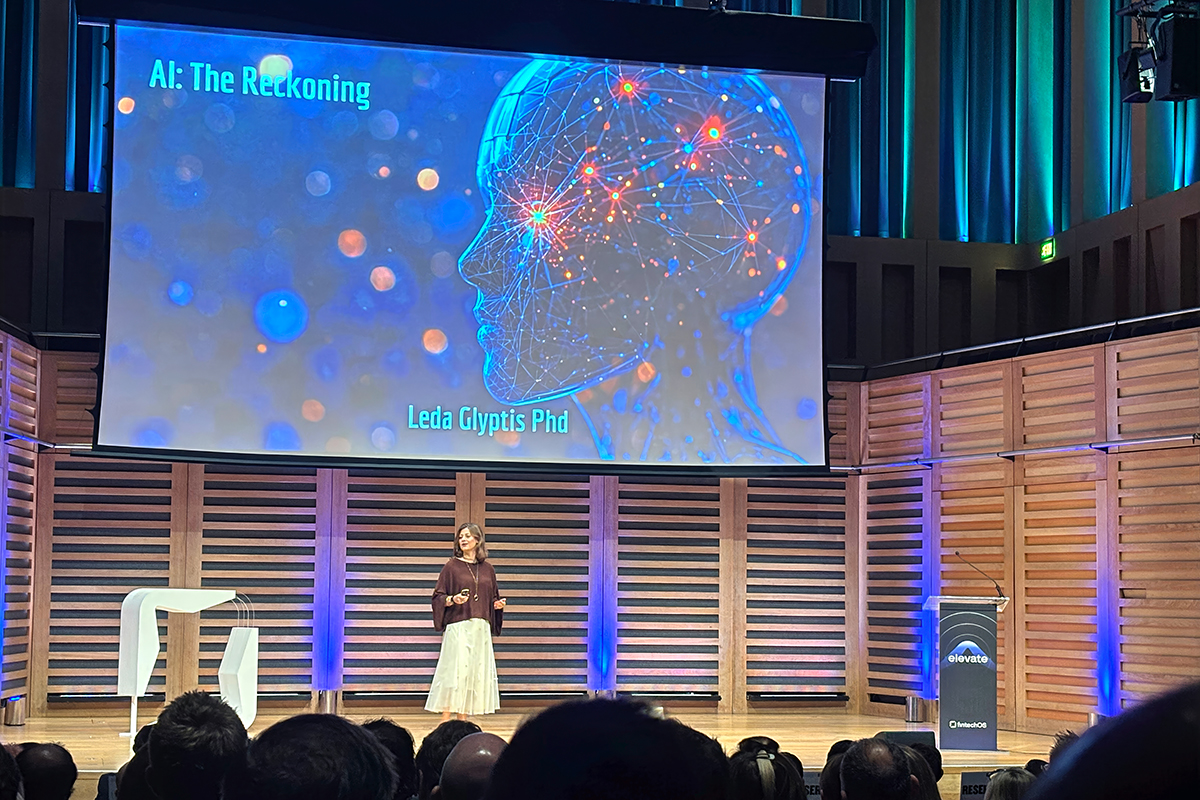
Financial services firms risk wasting substantial investment in artificial intelligence unless they fundamentally rethink their operating models, strengthen governance and focus on measurable business outcomes, according to industry commentator Leda Glyptis.
Delivering a keynote entitled ‘The AI Reckoning’ at FintechOS Elevate 26, Glyptis warned that banks, insurers and other financial institutions had enthusiastically embraced AI technology without necessarily achieving the operational improvements they had anticipated.
She argued that the industry had largely approached AI as another technology to add to existing systems and processes, rather than recognising its potential to transform how organisations operate.
“I would say that the biggest thing we may have done wrong is that we did the usual thing we do with new technology. We just put it on top of everything else,” she said.
“It’s actually a transformation story.”
Glyptis, who is a seasoned fintech executive and former banker, with a career spanning two decades working in transformation and technology functions across a variety of financial services verticals, said the financial services industry had spent unprecedented amounts of money experimenting with AI, with some organisations measuring adoption through the volume of AI usage rather than the value it generated.
She described the practice of ‘token maxing’, where employees were encouraged to maximise their consumption of AI resources, as an example of how organisations had confused activity with progress.

“The party’s over,” she said, explaining that financial institutions were increasingly introducing spending controls and demanding evidence of returns on their investment.
Despite the enthusiasm surrounding AI, Glyptis highlighted a disconnect between improvements reported by individual employees and measurable benefits across organisations.
She referred to research suggesting employees were saving approximately an hour and a half each day through AI-assisted working. However, she said these individual productivity gains were not translating into equivalent improvements at an organisational level.
According to Glyptis, the highest measurable operational improvement she had seen declared by a financial services organisation was just 6%.
She questioned whether such modest gains justified the scale of investment being made, particularly where fragmented processes and poor data management continued to limit the technology’s effectiveness.
For mortgage lenders, the implications extend to areas such as underwriting, document processing, customer servicing and the management of existing technology platforms, where introducing AI without addressing underlying operational weaknesses could simply add another layer of complexity.
GOVERNANCE BECOMES CRITICAL
A central theme of Glyptis’s presentation was the need for financial institutions to establish more effective controls over how AI is developed, deployed and monitored.
She warned that the ease with which employees could now create AI-powered applications and tools was generating new operational risks.
Glyptis described one organisation that had reportedly released 1,500 proofs of concept into production in a single day, illustrating the potential consequences of allowing experimentation to proceed without adequate oversight.
“Focus is a feature, not a bug,” she said.
She argued that organisations needed to distinguish between experimentation that genuinely improved business performance and activity that introduced unnecessary duplication, complexity and vulnerabilities.
“If you want to be successful at AI implementations, governance is your only friend,” she told delegates.
Glyptis also challenged the suggestion that AI systems could govern themselves, warning that regulated financial institutions could not delegate responsibility for operational decisions, risk management and compliance to technology.
She said traditional governance arrangements might themselves need to evolve to accommodate the speed and scale of AI development.
FRAUD AND CYBER RISKS
Glyptis also highlighted the growing relationship between AI adoption, fraud prevention and cybersecurity.
She warned that AI-powered threats were becoming increasingly sophisticated, including attacks capable of adapting their behaviour when detected.
However, she argued that the appropriate response was not to retreat from AI adoption.
Financial institutions needed to develop their own capabilities to defend against threats that could increasingly require AI-powered detection and prevention, she said.
She suggested that the insurance sector was showing signs of moving more quickly than banking in applying AI to areas such as fraud detection and risk management.
Glyptis also raised concerns about regulatory uncertainty, including questions around liability, data sovereignty and concentration risk arising from financial institutions’ dependence on a relatively small number of major technology providers.
CONSUMER ADOPTION REMAINS UNCERTAIN
Another challenge identified by Glyptis was the gap between financial institutions’ expectations for AI-driven transactions and consumers’ willingness to use them.
She referred to forthcoming research indicating that 78% of regulated financial institutions expected agentic transactions to become established by the end of 2026, while 74% of consumers were not yet comfortable with that prospect.
Although consumers were increasingly using AI tools for information gathering and everyday decisions, she said many remained reluctant to allow autonomous systems to initiate payments or authenticate their identities.
This created an unusual situation in which financial institutions were potentially moving ahead of consumer demand.
For mortgage providers and brokers, the distinction is particularly important given the complexity and significance of borrowing decisions, where customer confidence, transparency and accountability remain essential.
Glyptis suggested that the industry had an opportunity to use this period to strengthen its systems, engage with regulators and prepare customers for future developments.
A TRANSFORMATION OPPORTUNITY
Looking ahead, Glyptis urged financial institutions to concentrate on the foundations required to make AI effective, including data quality, technology architecture, operational resilience and organisational capabilities.
Rather than expecting AI to resolve longstanding problems automatically, she said businesses should first identify what was preventing them from operating more effectively and then consider how the technology could help address those barriers.
She also encouraged organisations to work with technology partners capable of supporting longer-term transformation rather than selecting suppliers solely on the basis of individual AI capabilities.
Her concluding message was that financial institutions should not allow enthusiasm for new technology to distract them from the fundamental changes required to deliver sustainable improvements.
“What’s slowing you down? What’s slowing your organisation down?” she asked delegates.
Whether the answer involved decision-making, talent, data or existing technology, Glyptis argued that addressing those underlying constraints would be essential to realising AI’s potential.
The industry, she suggested, had reached a point where the priority must shift from demonstrating what AI can do to proving what it can deliver.




