

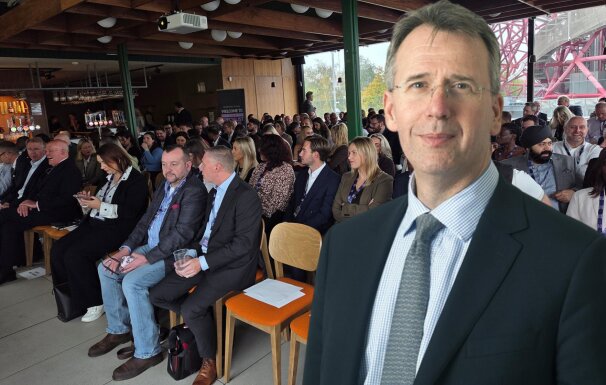
The UK economy could grow faster than official forecasts suggest with interest rates needing to fall further to unlock household spending, according to Darren Winder, head of Lazarus Economics & Strategy.
Speaking in London this morning at Brightstar Group’s Specialist Lending Expo 2025 Winder (main picture) challenged the Office for Budget Responsibility’s (OBR) caution, predicting growth of 2% in 2026 – well above the consensus view of around 1%.
“The OBR’s first move this autumn will be to revise up its numbers because the economy has done better than expected. They’ve been too pessimistic,” he said.
SAVINGS GLUT
He argued that the real drag on activity is not weak demand but the “savings glut” created by higher deposit rates.
UK households now hold around £200bn more in deposits than they have borrowed, a reversal of the position before the financial crisis.
“Households saved £200bn last year and are on track to save another £200bn this year. If they saved £150bn instead, the economy would be significantly stronger,” Winder told delegates.
LOWER RATES ESSENTIAL
With mortgage rates at about 4.25% and banks issuing around 65,000 new loans a month – far below pre-crisis averages – Winder said lower interest rates were essential to spur borrowing and spending.
“The way to close the gap between deposits and loans is through lower rates. We need to encourage people to save less and spend more.”
He was also sceptical of claims that tax rises are inevitable to plug a looming fiscal hole, pointing instead to the pandemic’s legacy costs of more than £360bn.
“The right path is to encourage spending, not saving.”
“If the outlook for growth is worse, raising taxes doesn’t make sense. The right path is to encourage spending, not saving,” he said.
On housing, Winder suggested scrapping stamp duty for homeowners over 60 to free up downsizing and improve mobility in the market. He also called for easing mortgage regulation to allow transaction levels to rise.
INFLATION FALL
Inflation, he argued, is likely to fall back sharply, with wage settlements now running at about 3% compared with over 5% a year ago.
“The Bank of England has already cut rates five times as inflation doubled, because it knows the pressures are temporary,” he said.
Winder rounded off his presentation concluding that the UK economy is on a gradual upward path: “Half a per cent in 2023, one per cent in 2024, one and a half in 2025 – the natural extension is 2% in 2026. I’m a lot more positive about the outlook than the consensus.”


