

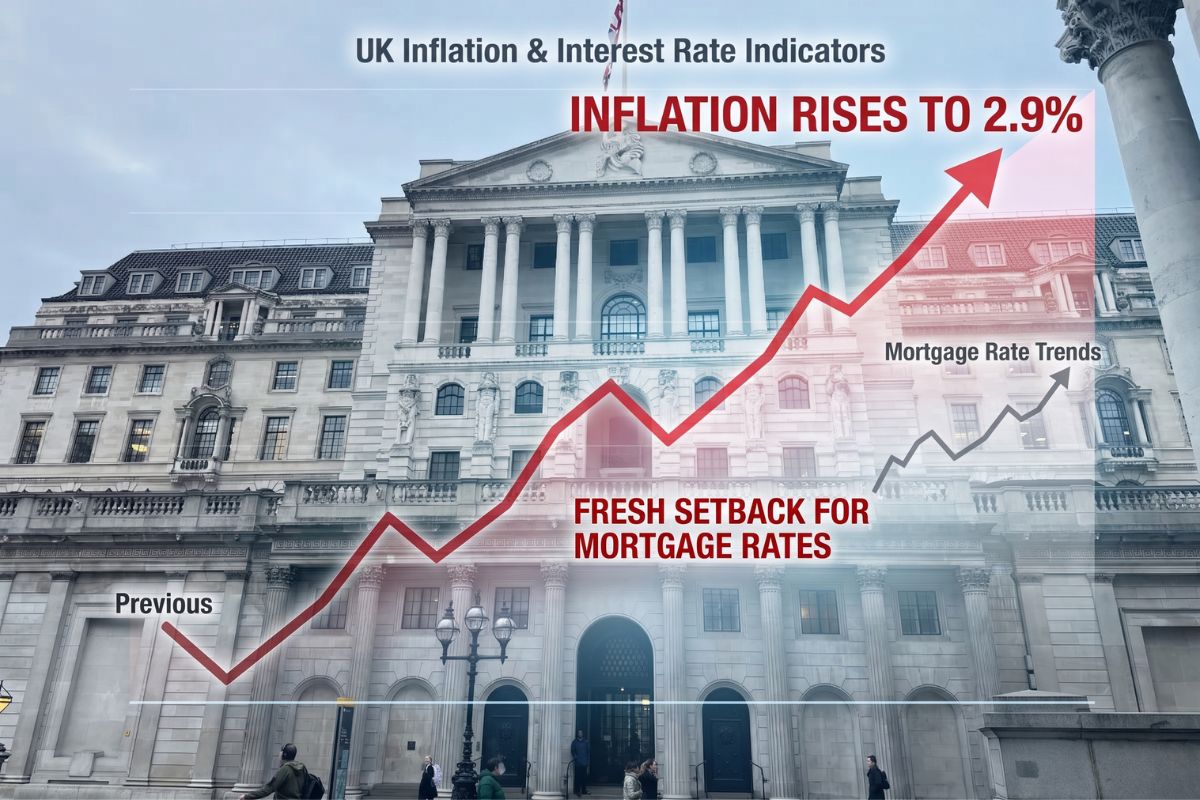
UK inflation increased to 2.9% in July, moving further above the Bank of England’s 2% target and reducing the prospect of an early cut to Bank Rate.
The Consumer Prices Index rose from 2.6% in June, when inflation had reached its lowest level since December 2024, according to the Office for National Statistics.
The increase had been widely expected following a 13% rise in Ofgem’s energy price cap from 1 July. The Bank of England previously estimated that higher energy costs would add around 0.4 percentage points to inflation.
For mortgage borrowers, the figure adds to an already uncertain interest rate outlook. Bank Rate remains at 3.75% after the Monetary Policy Committee voted by six to three to hold it in July, with the minority favouring an increase.
MORTGAGE RATE PRESSURE
Although Bank Rate does not directly determine the price of fixed mortgages, inflation expectations influence gilt yields and swap rates used by lenders when pricing new products.
Concern about the economic effects of higher energy costs and conflict in the Middle East has already contributed to volatility in wholesale markets, prompting lenders to reprice mortgage ranges during recent months.
A Reuters poll of economists published ahead of the inflation figures found that 56 of 64 respondents expected Bank Rate to remain at 3.75% for the rest of 2026. Inflation was also expected to move above 3% later in the year.
However, the Monetary Policy Committee must balance renewed price pressures against signs of a softer labour market and weaker private-sector wage growth. This makes an immediate rate increase far from certain, but the latest figures may extend the wait for borrowers hoping for cuts.
ENERGY DRIVES REVERSAL
The July increase reverses some of the progress recorded in June, when falling transport and food inflation helped bring CPI down from 2.8% to 2.6%.
Ofgem confirmed that energy prices for a typical household paying by direct debit would rise by 13% between July and September. The change affects customers on standard variable tariffs rather than households protected by fixed energy deals.
The next Bank Rate decision is due on 17 September.
A lower inflation rate would not mean prices were falling. Inflation measures the speed at which prices increase: at 2.9%, the average price level was still rising, and doing so more quickly than during June.
INDUSTRY REACTION

Richard Pike, sales and marketing director at Phoebus Software, said: “With the stop-start conflict in the Middle East continuing to fuel volatility in global oil prices, alongside last month’s increase in the energy price cap, a rebound in inflation from June’s 2.6% was always likely.
“July’s reading at 2.9% would usually put more pressure on the Bank of England to increase base rate in September to help curb rising prices.
“The last MPC vote was 6-3 to hold, and this latest reading will strengthen the hand of those calling for higher rates.
“However, with rising unemployment, house prices looking like they may start to reduce in many areas and the fact that grocery inflation is not nearly as bad as predicted means this is not a straight-forward decision.
“The Bank could take the view that as inflation is being driven by oil price rises, they need to give the public some respite.
“The road back to 2% is going to be a long and bumpy one and for lenders and borrowers alike, the coming months are likely to be defined by continued uncertainty.”
‘ALWAYS LIKELY’

Ben Thompson, director of home moving strategy at Mortgage Advice Bureau, said: “After last month’s surprise fall, an inflation bounce-back was always likely. Fuel prices have been climbing again since the last reading, so today’s rise doesn’t really tell us anything we didn’t expect.
“What actually matters is what this does to the Bank of England’s next move, because that’s what changes the mortgage deals available.
“First-time buyers should know that lenders don’t price fixed deals against today’s rate – they price them against where they expect rates to go next. That’s why inflation data can impact what’s available before the Bank does anything at all.
“The read is similar for anyone remortgaging, but the stakes are higher. If your current deal ends in the next few months, lenders typically start repricing in the run-up to a Bank decision, not after it. So, waiting to see what happens at the next base rate announcement in September could mean missing the deals that were only available beforehand.
‘BACK TO SQUARE ONE’

Emma Hollingworth, chief distribution officer at LSL Financial Services, said: “Today’s inflation data is a real blow for households and particularly worrying for homeowners, as it raises the prospect of an interest rate rise in the coming months.
“Fresh trouble in the Middle East has stoked fears of another bout of inflation, particularly if the Strait of Hormuz, a key artery in the global trade network, remains under threat. For borrowers, what happens to that shipping lane could have major ramifications for the cost of borrowing this year.
“The Bank of England is walking a tightrope again.”
“Against that backdrop, the Bank of England is walking a tightrope again. Some forecasters now see inflation topping 4% by this time next year, which would likely force the Bank’s hand on interest rates. While we don’t expect the Monetary Policy Committee (MPC) to move at next month’s meeting, the chances of at least one rise – and perhaps two – this year have grown dramatically.
“Swap rates have jumped since the US-Iran ceasefire fell apart in early July and, if inflation keeps rising, they will climb further. That matters enormously for the hundreds of thousands of borrowers refinancing in the second half of 2026.
“A few weeks ago, we thought we finally had some certainty but with conflict flaring again in the Middle East, we are back to square one. It’s moments like these that brokers earn their keep and therefore it’s vital they are reaching out to borrowers who have six months or less on their current deals to help them navigate the uncertainty.”
TIME TO BE PROACTIVE

Karl Wilkinson, founder and CEO of Access FS, said: “July’s inflation rise will come as little surprise given the pressure that rising energy costs have been putting on households and businesses, but it will still be a frustrating step backwards for the Bank of England.
“After the progress we’ve seen in recent months, the last thing rate setters need is another reminder that inflationary pressures can return quickly.
“The important question now is whether this is a temporary bump or the beginning of something more persistent. With wage growth also starting to cool and the labour market losing momentum, the Bank must balance the risk of inflation becoming entrenched against the risk of putting further pressure on an already weakening economy.
“For brokers, this is another reminder that clients need context rather than predictions.
“There is still plenty of competition among lenders and opportunities for borrowers, but we shouldn’t allow another inflationary surprise to make customers sit on their hands.
“Advisers need to be proactive, explain what the data actually means for individual borrowers and help clients make decisions based on their own circumstances rather than trying to time the market.”
OPPORTUNITY KNOCKS

John Phillips, CEO of Just Mortgages and Spicerhaart, said: “Inflation rising in July was widely expected following the increase in the Ofgem energy price cap in July.
“This is where the stop start Middle East conflict has had the most profound impact on the UK, which has otherwise seemed to fair reasonably well so far – as shown by recent resilient GDP data. Energy is expected to be a key driver of inflation in the back end of this year, as well as rising food costs as we see the impact of this persistent hot weather.
“While it is easy to get bogged down in this macro view, it’s important that we don’t miss the moves taking place in the mortgage market – most notably rate cuts from the likes of Nationwide, Santander, HSBC and Gen H this week.
“We shouldn’t let it dictate our conversations with potential clients.”
“There’s an argument to say more could be on the way as long-winded transaction times force lenders to think ahead to their end of year lending targets.
“So while it is important for us to be aware of the forces influencing our market, we shouldn’t let it dictate our conversations with potential clients – especially when there is still an ambition to buy.
“In reality, many consumers just don’t know that they can and it’s up to us, now more than ever, to be proactive and present opportunities to those potential borrowers who have the appetite and perhaps unknowingly have the ability too.”
VOLATILE BACKDROP

David Hollingworth, associate director at L&C Mortgages, said: “This morning’s increase to the rate of inflation edges further away from the Bank of England’s 2% target. The rise in the energy price cap means that an increase this month was a certainty.
“However, the increase is largely in line with market expectations, which is important from a mortgage borrowers’ perspective. Financial markets are already factoring in the threat of interest rates having to climb to combat higher inflation.
“Anything that would cause markets to fear a more severe hike would have implications for mortgage rates. Stubborn underlying price pressures would put more pressure on the Bank of England to lift interest rates, although it’s so far taken a balanced approach.
“Mortgage rates have risen since the outbreak of the Iran war although a more stable period in recent weeks has helped lenders to reverse some of those increases, trimming back their fixed rates. Lenders including Nationwide, Santander and HSBC have all announced reductions to fixed rates this week, bringing a more positive tone.
“Nonetheless, there remains a volatile backdrop and it’s impossible to rule out more yo-yoing in mortgage rates at this stage. The good news is that, because today’s increase in inflation was widely anticipated, it’s less likely for there to be big repercussions in markets that would put more pressure on lenders funding costs in the short term.”
DISAPPOINTING OUTLOOK

Sarah Pennells, consumer finance expert at Royal London, said: “The increase in the inflation rate is not unexpected, following the 13% rise in the energy price cap, which kicked in at the start of July.
“While the VAT reduction will lower the average annual household energy bill by around £44 from October, experts expect the overall energy price cap to rise again. We’ll find out how much by in coming days.
“The outlook will be disappointing for people who are already struggling with the cost of everyday essentials.
“Our research shows that three in ten adults are financially fragile, with one in eight having less than £50 left over once they’ve paid for the basics, highlighting just how little room many people have to absorb further price rises.”
FISCAL UNCERTAINTY

Nathan Emerson, CEO of Propertymark, said: “Today’s news may bring a renewed level of concern to many individuals and families, especially over the coming months regarding household outgoings.
“Significant fiscal uncertainty, both in the UK and globally, including concerns on energy prices over coming months, is potentially likely to keep inflation rates above pre-2021 levels for now, continuing to potentially impact affordability for existing homeowners and prospective buyers as the year progresses.”
UNDER PRESSURE

Louise Halliwell, group savings director, Kent Reliance, said: “Today’s rise in inflation is an added pressure to households already feeling the pinch.
“The increase in the energy price in July has been a driver to this and as we head to the end of summer energy usage will likely be on consumers’ minds.
“Our latest SaveUp research reflects that reality. More than a third (35.3%) of UK adults say they are saving less because of rising household bills, while almost one in five (19.8%) are using savings to cover everyday costs.”
More to follow…


