


The number of housebuilding companies being established in the UK has fallen by 34% since 2022, according to Connells Group analysis of Companies House data.
There were 6,815 new housebuilding companies set up in the first seven months of 2026, compared with 10,387 in the same period of 2022. Registrations were down 3.5% year on year.
The number of new entrants has fallen each year since Help to Buy closed to new applicants in England on 31 October 2022. Introduced in April 2013, the scheme provided government-backed equity loans to just under 400,000 buyers, most of them first-time buyers.
Meanwhile, the number of housebuilding companies being dissolved has risen by 21% since 2022. At the end of July 2026, 71,300 housebuilders were in business across the UK, down from a peak of just over 72,700 in May 2024.
Connells Group’s analysis puts the average life expectancy of a housebuilding company at 6.8 years, up from 6.3 years in 2023 but below the 7.1 years recorded in 2020.
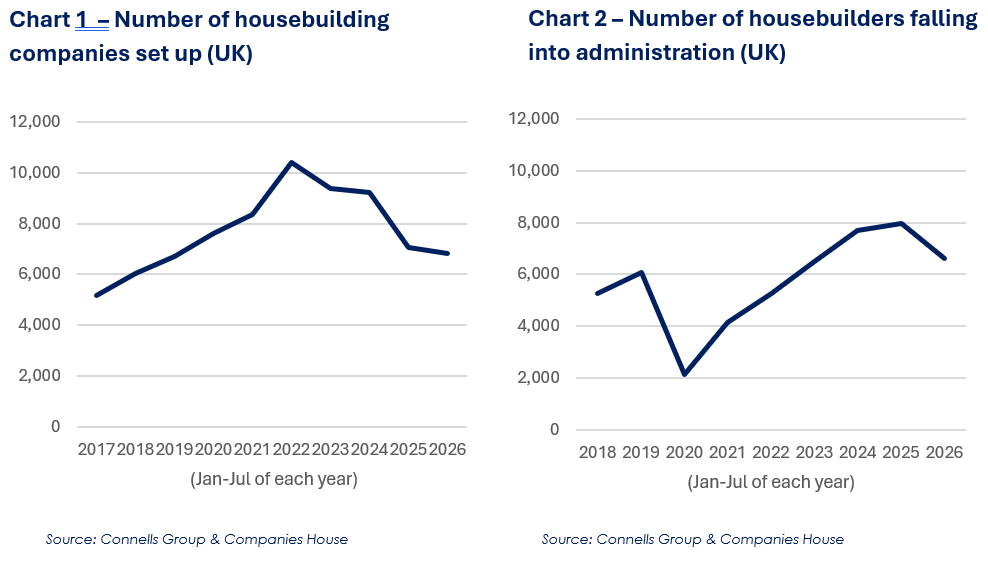
The group said the recovery suggested that some newer, more vulnerable businesses had already left the market, leaving a smaller pool of more established operators. Larger housebuilders had generally proved more resilient, with greater financial resources to withstand higher borrowing costs and longer sales periods.
Aneisha Beveridge, research director at Connells Group, said: “High interest rates, rising construction costs and weaker buyer confidence have increasingly deterred many new developers from entering the market.
“For a housebuilder brave enough to set up shop today, the operating environment remains far from easy.
“Until market conditions improve sufficiently, the number of housebuilders is likely to continue shrinking. This is compounded by an ageing workforce, which means many trade skills are being lost for good.
“Help to Buy’s epitaph is still being written, but it undoubtedly incentivised both existing housebuilders to build more homes, as well as enticing new developers into the market.
“While larger, established housebuilders have been better placed to absorb tougher conditions, newer players with less financial flexibility can’t afford to wait long for sales to roll in and have therefore struggled to make the numbers work.”
