

The Housing Secretary, Robert Jenrick, has announced a £3.5 billion fund to tackle unsafe cladding.
In addition, a new tax on the residential development sector which will be introduced in 2022 to help pay for combustible-material remediation on tower blocks.
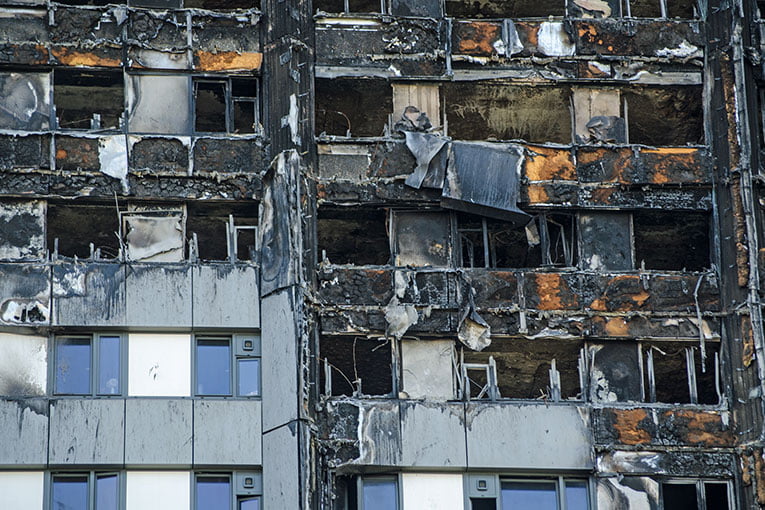
The issue of unsafe cladding was tragically brought home by the Grenfell Tower (pictured) disaster.
Tom Pemberton, a partner in Goodman Derrick LLP’s construction team. said: “Today’s announcement is welcome, but leaves many questions unanswered. In particular, the new funding will only cover the cost of replacing unsafe cladding systems on high-rise buildings over 18m high. It will therefore not provide any cover at all for lower-rise buildings, and it seems that it will not cover the cost of other essential work to make buildings of any height safe.
“For example, a fire risk is often presented by faulty smoke ventilation systems and combustible insulation inside the external wall (not the external cladding). These elements need to be signed off by accredited fire safety professionals before properties become mortgageable and marketable.
“The reality is therefore that those been hardest hit by this issue to date will continue to suffer months of uncertainty and anxiety until an acceptable solution is found which addresses all the wider safety issues.
“Developers, in the meantime, will no doubt question why they are being singled out to pay the costs of the new scheme by paying a levy on their future high-rise schemes, in addition to a tax on them which the government hopes to yield £2 billion over a decade.”
Jonathan Frankel, head of the property litigation department at Cavendish Legal Group, added: “The £3.5bn announced today is completely insufficient to deal with even a fraction of the blocks up and down the country where these repairs must take place.
“But the fact that it only applies to buildings over 18 metres will cause even more uncertainty for those residents and leaseholders living in lower rise blocks where they feel insecure and unsafe. It may be considered a lower risk, but it’s a risk nonetheless which will impact the saleability of their property.
“The leasehold protection scheme capping payment for repairs at £50 a month for leaseholders which has also been announced will bring little comfort to many who feel they shouldn’t have to pay for somebody else’s mistakes.”


