


The number of new buy-to-let companies being established has fallen this year as the transfer of existing landlord portfolios into corporate structures begins to run its course, according to Hamptons.
Analysis by the estate agency found that 41,483 buy-to-let companies were incorporated during the first eight months of 2026, down 8% from 44,802 over the same period last year.
The slowdown was particularly marked in August, when 4,198 buy-to-let companies were established, 22% fewer than the 5,363 recorded a year earlier.
This pushed buy-to-let companies down from the second to the fifth most common type of business established during the month. New mail order and online sales companies took the top position, with almost twice as many registrations.
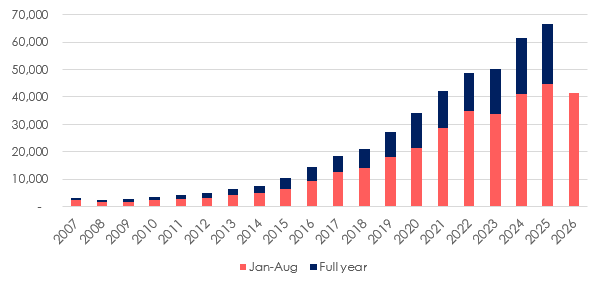
Hamptons said that if the current trend continues through the remainder of the year, 2026 will record the first full-year decline in new buy-to-let company formations since 2008.
However, around eight times as many buy-to-let companies are being created today as a decade ago, with limited companies continuing to offer tax advantages for many landlords.
The overall number of buy-to-let companies is also continuing to increase. There were 469,165 operating across Great Britain at the end of August, compared with 443,272 at the end of 2025, as incorporations continued to exceed closures.
PORTFOLIO TRANSFERS PASS THEIR PEAK
The increase in incorporation began following changes from 2016 to the taxation of landlords, including restrictions on mortgage interest tax relief for properties held personally.
Hamptons said further increases in the tax burden on personally owned rental property have made company ownership increasingly attractive, particularly for investors able to retain rental profits within a business rather than draw them as income.
Much of the subsequent growth in buy-to-let companies has come not from new investors but existing landlords transferring properties from personal ownership into limited companies.
About 81,800 properties were placed into buy-to-let limited companies in England and Wales during 2025, either through a purchase or transfer. Around 43,400, or 53%, were transfers from personal to company ownership by existing landlords.
Hamptons estimates the average Stamp Duty Land Tax bill associated with these transactions was about £28,000, based on an average property price of £380,000. This generated approximately £1.2 billion for the Treasury.
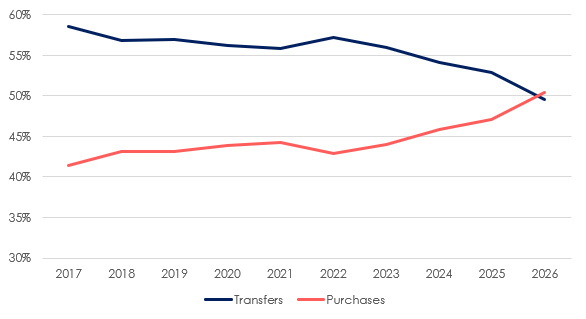
The agency believes the market has now passed the peak for such transfers. Many landlords for whom incorporation is financially advantageous have already moved their properties, while the upfront costs can make the process unattractive for lower-rate taxpayers and those considering selling in the short to medium term.
As a result, Hamptons expects 2026 to represent a turning point. It estimates that 51% of homes entering limited company ownership so far this year have been new purchases rather than transfers of properties already owned personally.
Future company formation levels are therefore expected to become more closely linked to landlords making new acquisitions, rather than restructuring existing portfolios. Hamptons said this was also likely to reduce the Treasury’s Stamp Duty receipts from buy-to-let incorporation transfers.
RENTAL GROWTH ACCELERATES
Meanwhile, annual rental growth on newly let properties accelerated for the tenth consecutive month in August.
Across Great Britain, the average rent on a new let rose 2.4% over the year to £1,419 a month, the fastest annual increase since November 2024.
Growth was strongest outside London, with new-let rents increasing by 5.4% in the South West and 3.7% in the South East.
August was also the first month in which the average cost of a newly rented home in the North exceeded £1,000. Rents increased 2.8% from £986 to £1,014 a month.
Greater London recorded more modest growth, with the average new-let rent rising 1.2% to £2,334. Across Great Britain excluding London, new-let rents increased 3.0% to £1,185.
For all tenants, rather than only those taking a new tenancy, the average rent increased 2.0% over the year to £1,260 a month. This was £159 below the average paid by tenants moving into a new property.
The average rent increase for an existing tenant, where an increase took place, remained at 5.6%. Scotland recorded the largest average increase at 6.9% in August.
Aneisha Beveridge, head of research at Hamptons, said: “A large part of the buy-to-let incorporation boom was driven by the one-off structural shift whereby existing landlords transferred properties they already owned into limited company structures in response to tax changes. But we’re now reaching the tail end of that trend.
“Increasingly, the landlords who stand to benefit financially from incorporating existing properties have already done so.
“While limited companies remain the preferred structure for most new investors entering the market, it’s likely that new company formations peaked in 2025. Moving forward, growth is likely to increasingly depend more on landlords making new purchases than restructuring portfolios.
“That also means the Treasury’s Stamp Duty windfall from these transfers is likely to start falling.
“Rental growth for new lets has been steadily gathering pace for nearly a year now, with much of that increase being driven by markets outside London. The arrival of the Renters’ Rights Act seems to be adding further pressure.
“Higher compliance costs and extra administration have left prospective tenants facing increased prices to secure new tenancies, even while existing renters are seeing more modest increases.”


