


The length of the Office for Budget Responsibility’s observation window – the period when it takes a snapshot of the economy to inform its forecasts – came under scrutiny last week.
It may sound like a dull technical detail, but it could have real consequences as the Treasury decides which taxes to raise in the Budget.
The trigger was the reaction on financial markets to last week’s downbeat labour market data, which saw unemployment climb to a four-year high of 4.8% and wage growth slow by more than expected.
Markets took this as evidence that inflationary pressures were easing, and the Bank of England could cut rates sooner.
FISCAL OUTLOOK
As a result, gilt yields, or government borrowing costs, fell – with the 10-year rate slipping below 4.5% on Friday morning, down from more than 4.7% a week earlier.
The fall won’t transform the fiscal outlook, but small movements can matter.
It could lower OBR assumptions around the government’s debt interest costs and give the Chancellor more room for manoeuvre in the Budget.
If the decline took place inside the window, it would have been cheered inside the Treasury. If not, you can imagine the frustration.
We will only know for sure when the Budget is delivered on 26 November.
Any fall in interest costs would reduce the pressure on the Chancellor to raise property taxes to close the estimated £30 billion fiscal gap.
That said, the odds of the property market emerging unscathed from the Budget still feel slim.
MANNA FROM HEAVEN
Speaking on the latest episode of the Housing Unpacked podcast, Pepperstone analyst Michael Brown said part of the fall may have been captured by the OBR based on previous timings.

It would be “manna from heaven for a Chancellor who is working with absolutely wafer-thin margins in terms of the fiscal headroom that she’s got,” he said.
Other topics covered include why scrapping stamp duty in November’s Budget will be difficult, the reliability of official economic data, the re-emergence of global trade tensions and whether the Chancellor uses a Bloomberg terminal.
The next key moment comes in mid-November, when the Treasury submits its Budget plans to the OBR. It’s a process that will trigger more back and forth and, quite possibly, more trial balloons in the media.
It follows a summer of speculation about potential measures from stamp duty reform and re-banded council tax to capital gains tax on main residences.
PLAUSIBLE MEASURES
Another possibility raised was levying national insurance on rental income, a policy that has previously been advocated by the Resolution Foundation, once led by Torsten Bell MP, who is now a key architect of the Budget.
However, the government would need to consider the inflationary risks if any extra costs are passed on or more landlords leave the sector. Entrenched UK inflation is something the IMF warned about last week.
Another of the more plausible measures floated in the media recently is altering council tax bands for higher-value properties, according to James Nation, a former special advisor to Rishi Sunak when he was Chancellor, speaking on a recent episode of Housing Unpacked.
If the proceeds can be directed to central government, it would produce a reliable flow of revenue, as opposed to transaction-based taxes, which often have unintended behavioural responses.
Either way, speculation is unhelpfully building across the whole economy, creating a sense of déjà vu following a similar period of uncertainty in 2024.
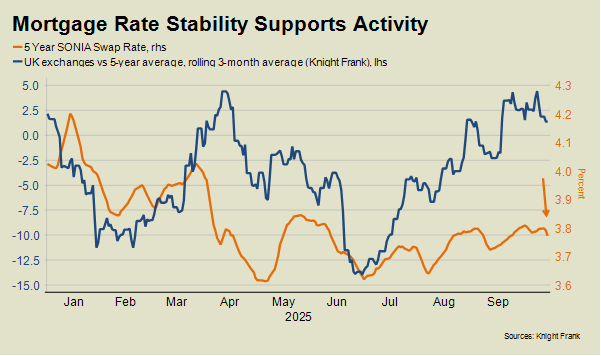
One positive piece of news in recent months has been the stability of mortgage rates, as the chart shows.
The availability of sub-4% mortgages has supported transactions, which have risen above their five-year average in recent weeks, as Knight Frank data shows.
Last week’s disappointing jobs data also pushed swap rates lower, which means further downwards pressure on mortgage rates, as the chart also shows.
However, activity has been concentrated in lower-price brackets, where pre-Budget tax speculation has been less intense. In prime markets, the overwhelming approach of buyers and sellers has been one of ‘wait-and-see’.
The risk for the Treasury is that this short-term caution also becomes entrenched.


