

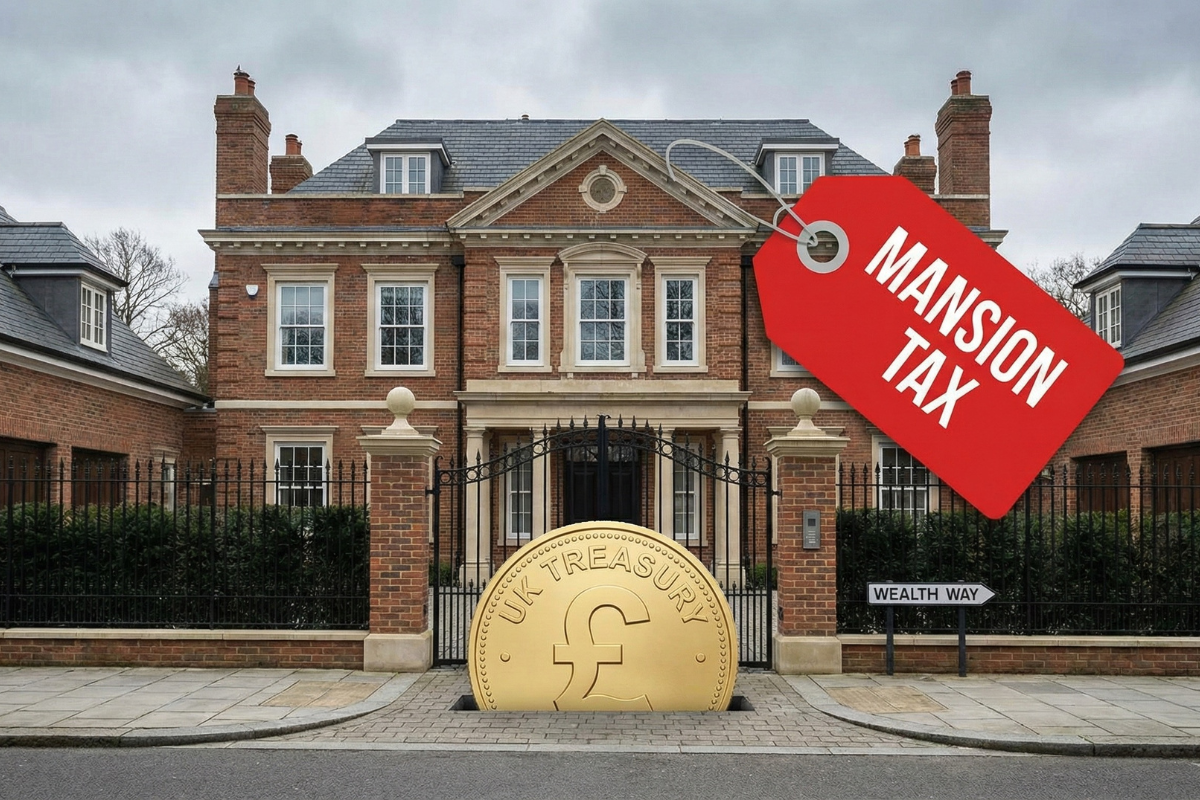
Most homeowners support the Government’s new Mansion Tax but remain sceptical about how it will affect the housing market, investor behaviour and Labour’s political standing, according to new research from mortgage broker Boon Brokers.
The survey of more than 1,000 homeowners across England, conducted by TLF Research, examined public attitudes towards the high-value council tax surcharge confirmed in the Autumn Budget.
From April 2028, properties worth more than £2 million will face an additional annual charge starting at £2,500 and rising to £7,500 for homes over £5 million.
The policy has been framed by ministers as a fairness measure and the public appears largely to agree: 66% of respondents said wealthier homeowners should contribute more to public spending.
MARKET IMPACT
The research suggests broad acceptance that those living in high-value properties can absorb the cost without significant financial strain.
However, the findings point to doubts about how the tax will affect the property market. Some 42% of respondents believe owners of high-value homes will raise asking prices to offset the surcharge, while 33% think the tax will reduce demand and push prices lower.
“The split highlights uncertainty over how the top end of the market will respond.”
Economists have warned that such taxes typically dampen buyer appetite rather than push prices up and the Centre for Policy Studies has suggested that the surcharge could slow high-end market activity and curb international investment. Boon Brokers’ research indicates that the public may underestimate these risks.
Despite those warnings, most respondents do not expect the surcharge to deter wealthy investors.
WIDER IMPLICATIONS
A majority, 53%, said the tax would not reduce investment in UK property and 54% believe wider economic investment will remain unchanged. Respondents largely viewed affluent investors as resilient to incremental tax rises.
This contrasts with recent wealth-migration data showing that the UK has experienced a net outflow of high-net-worth individuals amid higher taxes and global competition for mobile capital.
The study also explored the political implications of the Mansion Tax. Only 22% of respondents think the policy will improve Labour’s popularity while 40% believe it will make no difference and 38% say it could reduce support.
NOT A POLITICAL WIN
A separate question on Labour’s proposal to extend National Insurance to landlords’ rental income found 51% believe it would harm the party’s standing.
The research suggests that while the public supports the principle of taxing expensive homes, the measure is not seen as a political win and is viewed as having limited real-world impact.
As implementation approaches in 2028, the debate is likely to centre on whether the tax raises meaningful revenue without discouraging investment at the top of the market.

Gerard Boon, Managing Director of Boon Brokers, said: “The data shows that the public see a tax on high-value homes as both fair and proportionate.
“What is of particular interest is the suggestion that wealth-focused measures are broadly accepted with the conclusion that those with high-value assets can naturally afford them.”


