

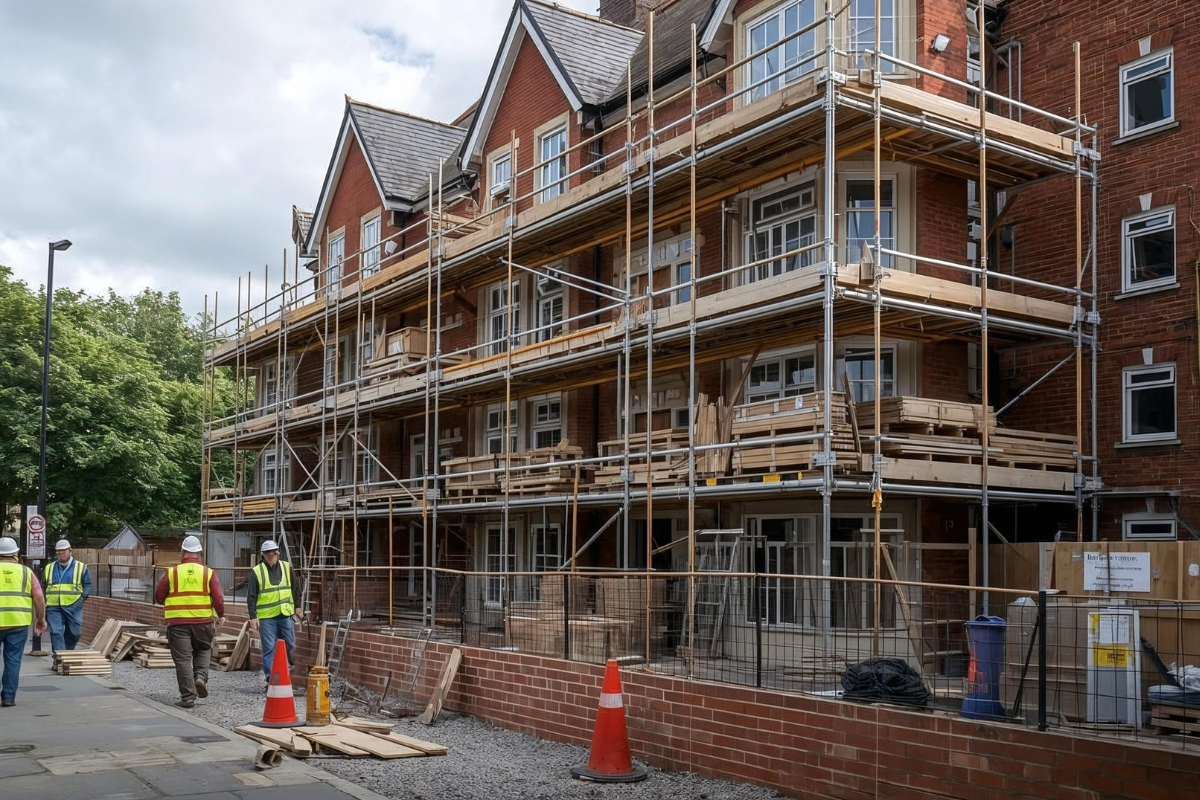
Government intervention is actively undermining the UK’s ability to meet its housing targets as a slowdown in housebuilding collides with rising costs, skills shortages and planning bottlenecks.
The Housing Oversight Committee, chaired by former Liberal Democrat leader Sir Vince Cable, says housing delivery was already falling short before recent policy changes and is now at risk of deteriorating further.
The committee warns that a combination of weaker developer confidence, higher regulatory costs and constrained local authority capacity is pushing the Government’s ambition to deliver 1.5 million new homes further out of reach.
New build housing, which accounts for at most 1% of the UK’s total housing stock in any given year, is being hit by a convergence of pressures.
BUILDING SAFETY LEVY
A marked slowdown in construction activity is being compounded by the Building Safety Levy due to take effect in October 2026, tighter high-rise safety rules and a chronic lack of skilled construction workers and planning professionals.
The committee says these factors are not only delaying schemes already in the pipeline but also threatening the viability of future developments, particularly those that include affordable or social housing.
Despite widespread acknowledgement of severe pressure on social housing, the group found little evidence that local authorities are reviving large-scale building programmes or expanding in-house capacity.
The Housing Oversight Committee is sponsored by The Family Building Society and brings together senior figures from across housing, economics and public policy.
Its members include Neil Jefferson, chief executive of the Home Builders Federation; Vicky Pryce, chief economist at the Centre for Economics and Business Research; and Damien Green, chair of the Social Care Foundation.
“Reaching the 1.5 million new homes target will be extremely difficult.”

Sir Vince Cable said: “The Government is looking like its own worst enemy by trying to make building easier with one hand but making it more difficult one the other.
“It’s no good trying to speed up planning approvals while making it more expensive to build at the same time.
“Local Government reorganisation will only make it worse as councils amalgamate resources leading to even fewer planning officers employed than now.
“With new build forming only 1% of the housing stock at most, policies encouraging improving existing properties and downsizing are essential otherwise reaching the 1.5 million new homes target will be extremely difficult.”
NEW BUILD PROBLEM
The committee’s assessment is that the Government’s heavy reliance on new build as the primary lever for increasing housing supply is itself part of the problem.
Members argue that the emphasis on large developments, combined with lengthy planning processes, creates long delays between application and decision, slowing delivery even where demand is strongest.
STRUCTURAL BARRIERS
At its latest meeting, the committee set out a series of structural barriers that it believes are preventing progress.
These include the ongoing slowdown in new build activity and a persistent lack of affordable homes; the introduction of the Building Safety Levy in October 2026, which it says threatens the financial viability of many schemes; and new high-rise safety rules that are increasing costs for both new build and refurbishment projects.
A shortage of skills capacity is also cited as a critical constraint, particularly the lack of experienced planning officers in some areas, leading to prolonged delays.
The committee warns that local government reorganisation could exacerbate the problem further, with councils amalgamating resources, postponing decisions and employing even fewer planning officers overall.
COST FACTOR
The committee also says that planning systems in parts of Europe operate at significantly lower cost, allowing for greater innovation and faster decision-making.
In contrast, the UK’s expensive and complex planning framework is discouraging development and limiting experimentation in design and delivery.
Taken together, the committee argues, these issues risk leaving the Government with ambitious housing targets but diminishing means to achieve them.
Without a broader strategy that goes beyond new build – including measures to improve existing housing stock and encourage downsizing – the group warns that delivery will continue to lag behind political promises.


