

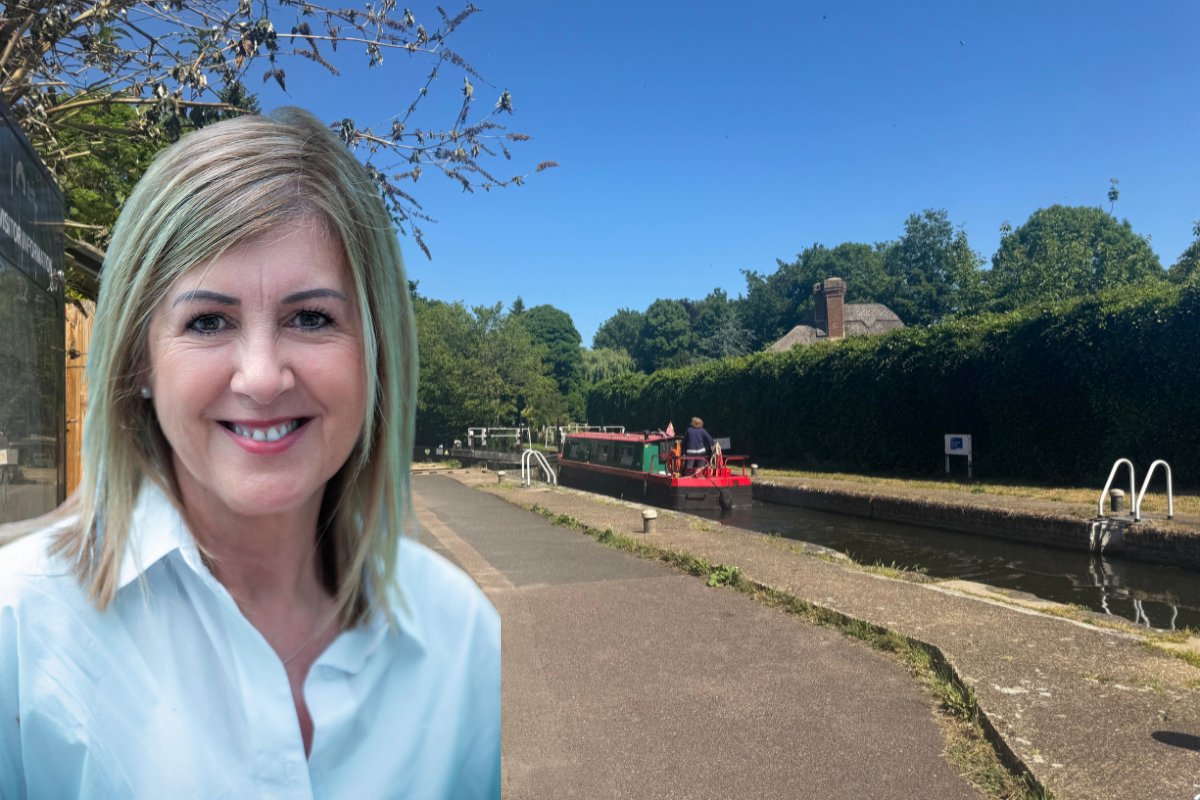
The Mortgage Industry Mental Health Charter (MIMHC) began its third annual 144-mile Walk & Talk challenge on Sunday and will finish on Friday this week. There are some 72 participants from across the mortgage sector taking part.
The six-day initiative follows the Grand Union Canal, with individuals joining for different stages of the route.

The event is led by Jason Berry, group sales director at Crystal Specialist Finance and co-founder of the Mortgage Industry Mental Health Charter, who will complete the full route alongside Charlie Morley, director of mortgage distribution, operations and servicing at Metro Bank.
Today, Lesley Cappellaro (main picture, inset), Barclays Regional Manager – West Region, is under the spotlight.
MS: What made you want to support and be part of the Walk and Talk initiative / event?
Over many years in the mortgage industry I’ve supported countless initiatives, but mental health is the area where I’ve always felt I could do more.
As someone who is naturally resilient, it’s easy to underestimate how much others can struggle and that’s exactly why it matters.
When I heard about Walk and Talk, it felt like the perfect fit: I love being outdoors, I love walking and above all, I love listening.
There’s something uniquely powerful about conversation that happens side by side, away from screens and meeting rooms and I’m honoured to be part of it.
MS: From your perspective, what are the biggest challenges brokers / clients are facing right now with their mental health and wellbeing?
Brokers are trusted advisers, but they frequently find themselves acting as informal counsellors too, absorbing the anxieties and fears of clients facing some of the biggest financial decisions of their lives, often without any formal training to support that role.
Add to that the relentless pace of market change, the expectation to always have the answers and the heartbreak of watching a client’s dream home become unaffordable overnight and it’s clear the emotional labour is immense.
We simply don’t talk about it enough.
MS: What is your organisation doing to better support staff and the wider market?
We’ve worked hard to build a culture where people feel genuinely safe to speak up. All leaders have access to dedicated support resources, because we believe you can’t effectively support your team if you’re not supported yourself.
Across the business we have peer support networks and wellbeing groups that give people a space to connect and be heard without judgement and we actively encourage open conversations that normalise help-seeking rather than treating it as a sign of weakness.
MS: Looking ahead, what trends or changes would you like to see in the next 12–24 months?
We’re living through overlapping pressures and the risk of burnout across our industry is very real.
I’d love to see us move from awareness to action: less reactive support when someone hits crisis point, and more proactive wellbeing built into how businesses operate day to day.
More events like this one too, because human connection and conversation remain some of the most powerful tools we have.
MS: What does success from this initiative / event look like for you?
For me, success isn’t measured in miles, it’s measured in conversations.
I’m looking forward to connecting with people I wouldn’t ordinarily cross paths with, hearing about their experiences and what they do to protect their own wellbeing while supporting those around them.
If I come away having made someone feel truly heard, or having sparked even one conversation that helps someone take a step towards getting support, that’s everything.
Mental health doesn’t have an easy fix but it nearly always has a starting point, and that starting point is someone willing to listen.


