

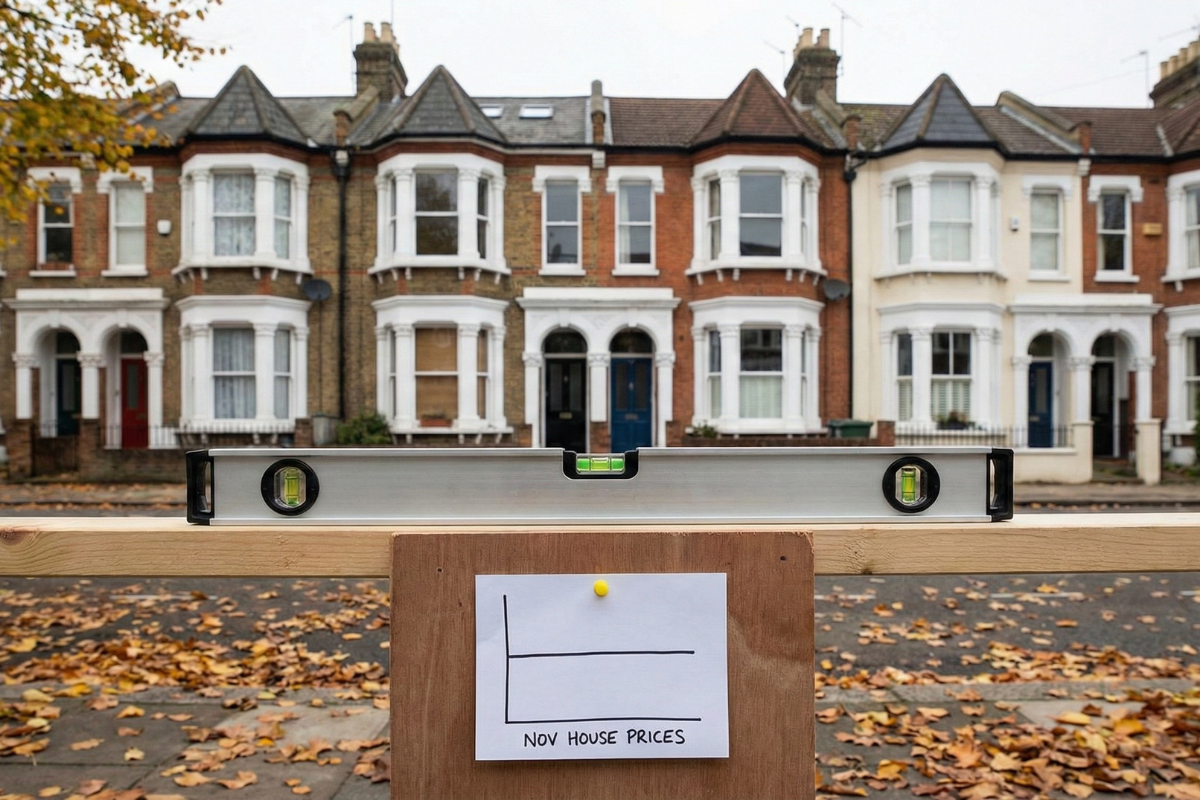
UK house prices were flat in November, pausing after a 0.5% rise in October, according to Halifax’s latest house price index.
The average UK property now stands at £299,892, a marginal monthly increase of £138 and a new record high.
Annual price growth slowed sharply to 0.7%, down from 1.9% the previous month, the weakest reading since March 2024. Halifax said the slowdown largely reflects the “base effect” of much stronger growth recorded a year ago.

Amanda Bryden, head of mortgages at Halifax, said: “Average house prices were broadly unchanged in November, edging up by £138 compared to October, with the typical property now costing £299,892.
“Annual growth has slowed to +0.7%, the weakest rate since March 2024, though this largely reflects the base effect of much stronger price growth this time last year.
“This consistency in average prices reflects what has been one of the most stable years for the housing market over the last decade. Even with the changes to stamp duty back in spring and some uncertainty ahead of the Autumn Budget, property values have remained steady.”
FIRST-TIME BUYER BOOST
She added: “While slower growth may disappoint some existing homeowners, it’s welcome news for first-time buyers.
“Comparing property prices to average incomes, affordability is now at its strongest since late 2015. Taking into account today’s higher interest rates, mortgage costs as a share of income are at their lowest level in around three years.
“Looking ahead, with market activity steady and expectations of further interest rate reductions to come, we anticipate property prices will continue to grow gradually into 2026.”
NORTH-SOUTH DIVIDE PERSISTS
The regional picture continues to show a marked split. Northern Ireland remains the strongest performing nation or region, with prices up 8.9% year-on-year to £220,716. Scotland saw annual growth of 3.7%, while Wales recorded a 1.9% rise.
In England, the North West led with 3.2% annual growth, followed by the North East at 2.9%.
By contrast, three southern regions saw prices fall in November. London dropped 1.0%, the South East fell 0.3%, and Eastern England edged down 0.1%. London remains the most expensive region, with an average price of £539,766.
Halifax said the data underlines the continuing affordability pressure in higher-priced southern markets, while lower-cost regions are showing greater resilience as activity remains steady heading into 2026.
INDUSTRY REACTION

Joe Nellis, economic adviser at MHA, the accountancy and advisory firm, said: “The market has moved away from the sharper declines seen in late 2023 but the recovery remains gradual, uneven and sensitive to broader economic conditions.
“The London market tells its own story. Average house prices have declined in recent months, as mortgage servicing costs still absorb a significant share of household income.
The Autumn Budget adds an additional layer of complexity. The surcharge on high-value properties will disproportionally impact London (where more properties are valued at over £2m), potentially discouraging purchases of luxury homes and dampening price growth in prime locations.”
BUY-TO-LET MARKET
He added: “A 2% rise in tax on rental income will have some impact on the buy-to-let market as landlords face a squeeze on their margins, but this is unlikely to drive any significant downturn in house prices.
“However, this could have a negative effect on renters – with landlords facing increased costs, they could look to pass this onto renters or refrain from investing in rental properties, with both outcomes ultimately leading to increased rents.”
IMPROVING AFFORDABILITY

Mark Harris, chief executive of mortgage broker SPF Private Clients, said: “Affordability is improving as lenders ease criteria and reduce rates, which is putting those ready to proceed with their purchases now that the Budget is out of the way in a stronger position.
“Although the Bank of England held interest rates at the last meeting, the vote was closer than expected with four of the nine members favouring a rate cut, which bodes well for a further reduction in December.
“Market expectations are for another rate cut before the end of the year, with lenders reducing rates in recent days in an effort to drum up business before year end.”
CAUTIOUS MOMENTUM

Karen Noye, mortgage expert at Quilter, said: “The market has not moved an inch in what has been a very static period as many buyers waited for clarity on housing measures in the budget.
“The dust has now settled post budget, giving borrowers a clearer view of what the early months of 2026 may look like.
“Affordability remains the biggest hurdle. Inflation has eased and there is growing expectation of a first rate cut in December, but mortgage pricing is still sensitive to shifts in swap rates and global pressures.
“Fixed rates have dipped, yet progress is gradual and high living costs continue to limit how far borrowing power can stretch, particularly for first time buyers.
“Mortgage activity shows a market that wants to move but is still cautious. Lenders are competing harder at lower loan to value bands, while higher LTV deals remain expensive.
SEASONAL SLOWDOWN

Steve Griffiths, commercial director for retail mortgages at Shawbrook, said: “A seasonal slowdown combined with buyers pausing for the Autumn Budget likely contributed to the softer picture, reflecting ongoing caution in an affordability-challenged market.
“The Budget ultimately delivered little to boost movement with no new support for first-time buyers or downsizers which will leave the sector wanting more. As we head toward 2026, expectations point to moderate and steady growth, but additional Government action would help support confidence during a still-challenging economic backdrop.”
MISSED OPPORTUNITY

Tomer Aboody, director of specialist lender MT Finance, says: “The fear of what the Budget might hold for the housing market encouraged some to make their move in November, rather than waiting for the outcome.
“Precious little encouragement from the Government to make moving more attractive is having an impact on the market. Property prices are being supported by lack of stock and competition among buyers for what is available.
“The Budget was an opportunity missed, with no measures to boost transactions so we don’t expect a significant improvement in the new year. That said, a further interest rate reduction would help affordability and confidence.”


